
Let’s talk Obesity Medicine and What’s Changing: Interview with Doctor Lindsay Ogle, MD

If you’ve ever wondered why your doctor is suddenly talking about obesity differently than they did ten years ago, you’re not alone. With new research, new obesity medicine, and a fresh way of understanding how weight works in the body, the game has changed. I interviewed an obesity medicine doctor, Lindsay Ogle, MD to answer your most pressing questions.
In this blog post, we’ll explore how the medical world now views obesity, what that means for FDA-approved anti-obesity medications, and how new treatments can support your journey. (Watch the full video below and don’t forget to download your free handout, too!)
Obesity Medicine Doctor interview with Dr. Lindsay Ogle on May 13, 2025
Obesity is a disease. Here’s why that matters.
Recognizing obesity as a disease has changed how we treat it. it. This new approach has opened doors to more research, new medications, and (hopefully) better insurance coverage. It also helps take the shame out of the conversation. It’s not about willpower. It’s about biology. Let’s dive into this exciting Obesity medicine interview with Doctor Lindsay Ogle.
How do we know if treatment is working?
It’s not just about the number on the scale. Yes, BMI (Body Mass Index) is still used, but it’s an imperfect tool. Doctors now also use body composition scans, waist measurements, and visceral fat levels (the fat around your organs) to better understand health risks. Progress is more than pounds—it’s about improving energy and metabolic health.
What is a Board-Certified Obesity Medicine Physician?
A board-certified obesity physician starts out like any other doctor. Med school, residency, all the things. But then they go a couple of steps further. They do extra training, attend conferences, stay up to date on research, and take a board exam just to specialize in treating obesity. You can read more about Obesity Medicine Doctors on this blog!
Why that matters:
These doctors really know their stuff. They use the latest evidence-based tools and are amazing advocates. They’re not going to give you a one-size-fits-all plan. Instead, they listen, look at your full picture, and create a tailored treatment strategy. Bonus points: they are whizzes at prior authorizations and finding the best cost approach to medication treatment.

Let’s talk meds. What’s approved for obesity?
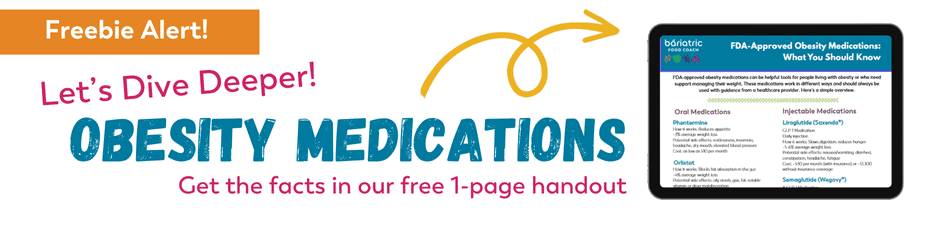
There are currently 7 FDA-approved medications for obesity. You may have heard of them:
Injectables (the GLP-1/GIP medications):
– Saxenda ® (liraglutide)
– Wegovy® (Semaglutide)
– Zepbound® (tirzepatide)
Oral medications:
– Phentermine
– Contrave® (naltrexone + bupropion)
– Qsymia® (phentermine + topiramate)
– Orlistat®
These medications each work differently. Some reduce appetite, others help with cravings, or help regulate blood sugar control and insulin. Curious how each one works? It’s all here: [handout link]
How much do these anti-obesity medications cost?
Oral meds: Can be as low as $10/month, but can be up to $100/month or more if not covered by insurance.
Injectables: Often are more expensive compared to oral medications. Without insurance coverage, injectables can cost over $1,300/month. Discount programs (like NovoCare® and LillyDirect™) can reduce the cost to ~$499/month.-
Tip: Some oral combination medications like Contrave® can be prescribed separately as generics (naltrexone + bupropion) to lower the price even more. I encourage you to have these discussions with your provider.
Dr. Ogle also mentioned trying name-brand GLP-1 prescriptions from out-of-country pharmacies for potential cost savings. She told me she would report back!
What is happening to compounded GLP-1 medications?
During a time of shortage, a medication that is under a patent can be made in a compound form. As of May 2025, all shortages have been declared over and no GLP-1 medications can be made in a compound anymore.
In our interview, Dr. Ogle is clear that it is an illegal practice for a pharmacy to sell a compounded form of a GLP-1 medicine after May 2025. Even if they add B12 or other ingredients to make that medication seem as if it’s not the same. She warns that there is concern about working with a pharmacy that is comfortable breaking the law.
Stick with FDA-approved options. If cost is a concern, talk with your provider—there may be safe, affordable options that are still effective.
Will I need to take medication forever?
Maybe. Obesity is a chronic condition, which means it usually needs long-term treatment. Think of it like high blood pressure—you manage it long term. If a medication helps with appetite, hunger cues, and metabolic health, stopping it can bring those symptoms back. That said, if your weight gain was short-term, you may not need long-term medication.

What about bariatric surgery?
Bariatric surgery can be a powerful tool, especially if medications haven’t worked or diabetes is difficult to manage. It’s not an either/or scenario—some people use medications before or after surgery to support their journey.
There is also a cost scenario for some where metabolic bariatric surgery may be the more affordable option in the end compared to long-term medication management.
And yes, medications can help after surgery
If you’ve hit a weight plateau or are experiencing weight reoccurrence more than a year post-op, your provider may suggest a medication to help manage the food noise.
Let’s bust a myth: These meds don’t just make you sick to eat less.
Yes, while some people can feel nausea at first, that’s not the goal. These medications work in three ways:
1) They block hunger signals in your brain
2) They slow how fast your stomach empties (so you feel full longer)
3) They help keep blood sugar and insulin levels stable
Less food noise. More steady energy. And yes, fewer cravings for carbs at 10 PM.

Nutrition still matters. Big time.
Eating on a GLP-1 is different—hunger is lower, portions are smaller, and your body responds to food shifts. That doesn’t mean your nutrition has to suffer. Whether you’ve had bariatric surgery or are on a medication like Wegovy® or Zepbound®, nutrition is still your foundation.
In my online course, What to Eat on a GLP-1, we focus on:
– Prioritizing protein and fiber
– Staying hydrated (and why that helps with energy and fullness)
– Building balanced meals that support muscle retention and steady energy
You won’t need to count every calorie or feel overwhelmed by vague nutrition advice. My goal is to help you feel more confident and in control of your food choices. If you’re looking to avoid common pitfalls like fatigue, muscle loss, or symptom swings, this course is for you.
What’s next in obesity treatment?
We’re seeing new combination medications in the works, plus new options being studied in clinical trials. We’re heading toward a future where obesity treatment is more accessible, effective, and personalized.
Want more support?
If you’re stuck, frustrated, or just want a plan that makes sense, check out my Premier Access Membership or explore 1:1 coaching. Already on a GLP-1? Don’t miss the What to Eat on a GLP-1 course—full of real-life strategies to help you feel your best.
* This blog was written and designed by dietetic intern, Josie Randall.